If you have ever had one unit of budget, mentorship, political cover, or key-relationship time and more than one person or project that needed it, and defaulted to giving it to the strongest candidate without examining why, this piece is for you. What you used was capability logic. There is another logic, and the moment you know both are available, the decision changes.
He told me he had twelve children.
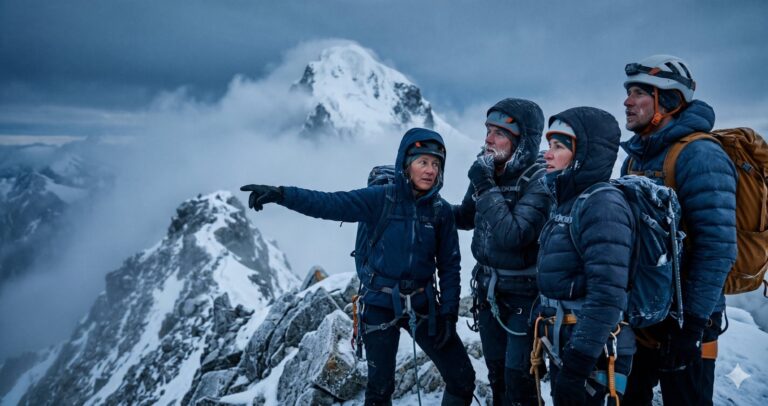
We had been hiking together for two days. A guide I had been assigned, a requirement of the Tanzanian park system that I had accepted without resistance and come to appreciate. He was a good man, unhurried in the way that people who know terrain are unhurried, attentive to conditions that I was still learning to read. We had talked on the approach. He had a family. Twelve children.
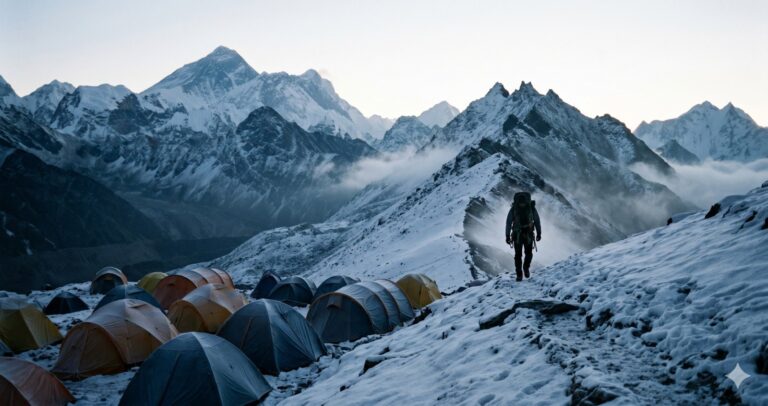
At midnight we left for the summit on the Arrow Glacier route. This route is not frequently used, the glacier itself is likely gone now, retreated in the years since that climb, another subtraction from the mountain’s permanent inventory. In the darkness before dawn, with headlamps, we moved upward.
Then we reached the traverse.
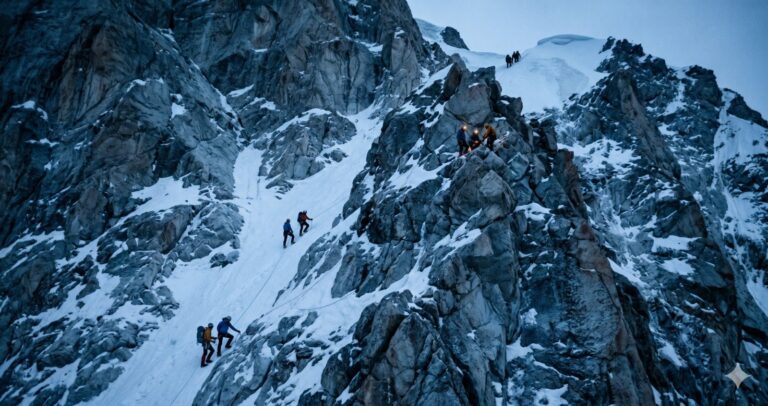
Two hundred to three hundred feet of icy, sloping rock and snow, crossing a face that dropped away into darkness below. I could not see how far the drop was. Far enough. The ice was hard. Neither of us had crampons. I had one ice axe, mine. The guide had nothing.
I looked at the traverse. I looked at the guide. I thought about twelve children.
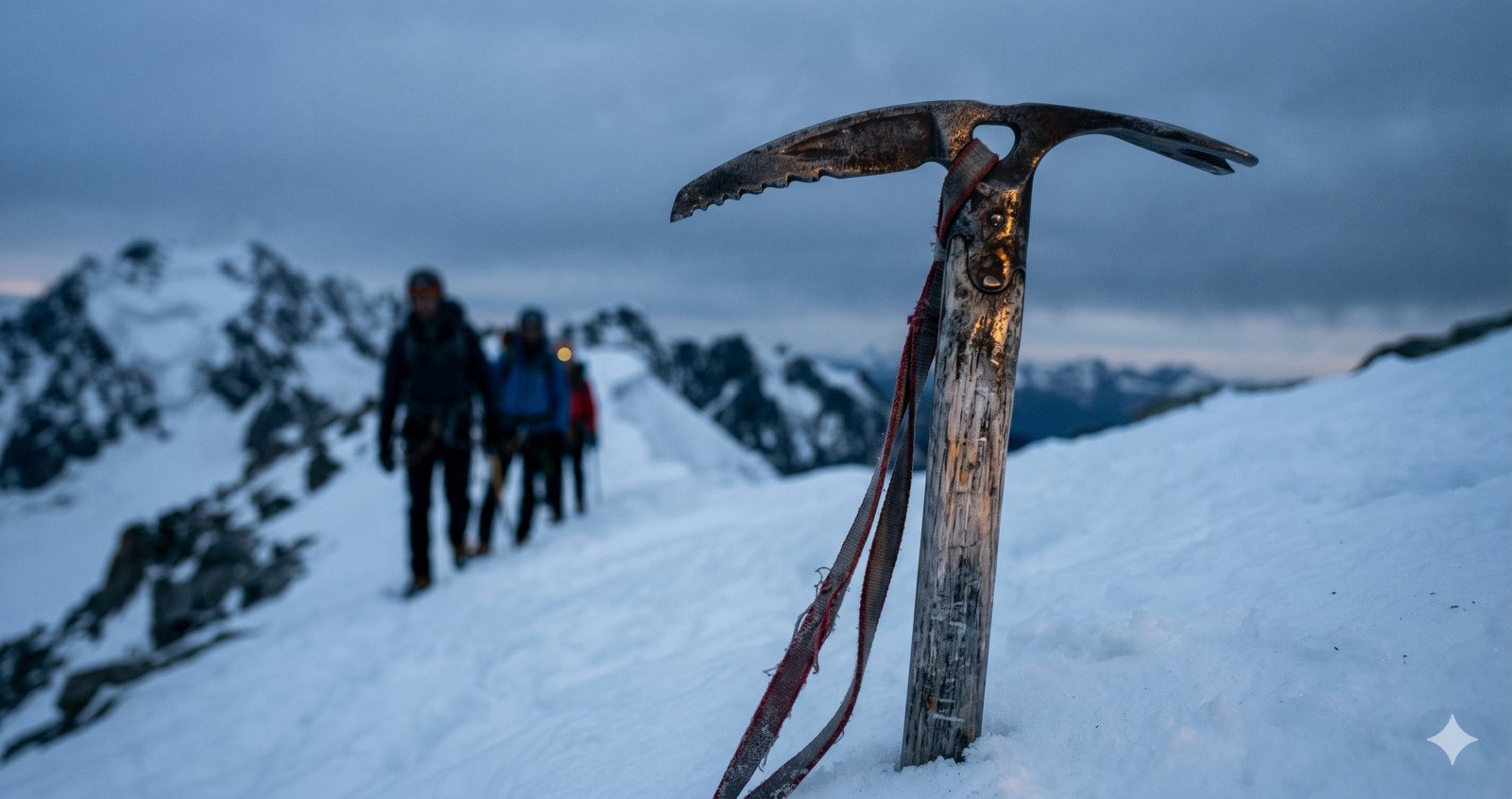
I gave him the ice axe.
He went first. I watched the beam of his headlamp move across the face, the axe finding purchase where his feet could not entirely trust the surface. Then I followed, in the dark, without the axe, making the same crossing on the same ice with nothing to stop a fall that I could not see the bottom of.
We crossed. We summited exactly at sunrise, pulling ourselves to the crater rim as the light came over the horizon, the wind strong enough that there was nobody else on the summit. Just the two of us, the light, the wind, and the particular silence of a high place reached at cost.
I have thought about the ice axe decision many times since.
The calculation that wasn’t
The technically correct decision, by any mountaineering risk framework, was to keep the axe.
I was the more experienced climber. I was more likely to know how to use it effectively in an emergency. The axe in my hands was statistically more useful than the axe in his. If one of us fell, the probability of self-arrest was higher with me holding it. This is the capability argument, and it is not wrong.
I did not make the capability calculation. I made a different calculation, faster and with less deliberation than the word “calculation” implies. Twelve children. He went first. If he fell on this traverse, twelve children lost their father. If I fell, the loss was real but the downstream consequences were different in kind and in scale.
This is a resource allocation decision made under irreversibility and time pressure, using a moral heuristic rather than a technical one. The heuristic was: give the protection to the person with the most dependents. Not to the most capable user. To the person for whom failure carries the heaviest consequence.
I did not know if this was correct. I still don’t, entirely. What I know is that it was the decision I made, and that we both crossed, and that the axe in his hands was not wasted.
“Give the protection to the person with the most dependents. Not to the most capable user. To the person for whom failure carries the heaviest consequence.”
What the ice axe actually is
In any team operating under genuine constraint, the ice axe problem appears in a different form. There is one unit of protection, one budget, one sponsor, one political shield, one experienced mentor, one key relationship, and more than one person or project that needs it.
The conventional allocation logic is capability. Give the protection to the person or project most likely to use it effectively, generate the best return, produce the most visible outcome. This logic is not wrong. It optimizes for the probability of the protection being well-used.
The alternative logic is consequence. Give the protection to the person or project for whom failure carries the heaviest downstream cost. Not the most capable. The most exposed.
These two logics produce different decisions and neither is always correct. The capability logic protects the investment. The consequence logic protects the system. In a well-resourced environment, you can often satisfy both. On an icy traverse before dawn with one ice axe and two people, you cannot. You choose.
The leader who has never been forced to choose between these two logics has not yet been on a real traverse. The leader who has chosen without knowing they were choosing, who defaulted to capability allocation because it felt more defensible, may have left the most exposed member of their team on the ice without support, for reasons that looked rigorous on a spreadsheet.
The guide went first
There is one more element of this decision that the resource allocation framework doesn’t fully capture.
I gave the guide the axe. And then he went first.
This was not incidental. The person with the protection leading the crossing is a specific configuration. It means the first person across has the best chance of survival, which also means the second person has a partially proven route and a partially established anchor point of confidence. The guide crossing safely in front of me was not just his survival. It was information. The route is passable, the ice holds, the axe is sufficient.
In organizations, this configuration appears whenever the leader gives a resource to a team member and then asks that team member to go first. To test the route, to take the initial exposure, to generate the information that the crossing is possible before others commit to it. This is not exploitation. It is the specific use of a protected team member as a pilot. The person best equipped to make the first crossing making it first, so that the information from their crossing is available to everyone who follows.
The guide went first because he had the axe. I followed because he had shown me the route was crossable. We both crossed because the decision about the axe was made correctly. Not by the capability logic, but by the consequence logic, with the person carrying the heaviest downstream weight carrying the protection first.
The summit
We pulled ourselves to the crater rim exactly at sunrise. The wind was strong enough that no one else had made the attempt that night. The summit was empty except for us and the light coming over the horizon.
There is a specific quality to a summit reached by a route that scared you. The Kilimanjaro crater rim at sunrise, after the traverse, in the wind, with two people who had crossed something difficult together and come through it. This is not the triumphant summit photograph. It is the quieter thing. The specific relief of a system that held, a decision that worked, a traverse that proved crossable.
We descended together, the way we had come, the axe back in my hand for the downclimb. The traverse was less frightening in daylight. The drop was visible now. Significant, but not what the darkness had made it feel like. The ice was the same ice. The daylight just let you see it accurately.
Most of the things that are most frightening in organizations are traverses crossed in the dark. The drop is real. It is also, frequently, not as far as the darkness made it feel. The decision about the axe is made before you can see the bottom. That is precisely when it has to be made.e decision about the axe is made before you can see the bottom. That is precisely when it has to be made.
THE TEAM TEST
Think about the last time you had one ice axe and more than one person who needed it.
Not a literal axe. The budget that was insufficient for all the priorities that required it. The experienced mentor whose time could go to one person or another. The political protection that could shield one project or one team member but not both. The key relationship that could be deployed for one outcome or another.
Now ask: what logic did you use to allocate it? Did you give the protection to the person most capable of using it, the capability logic? Or did you give it to the person for whom failure carried the heaviest consequence, the consequence logic?
And then ask the question that most leaders skip: who went first? Did the person who received the protection take the first exposure, test the route, absorb the initial risk, or did they hold the protection while someone else crossed without it?
The axe is only as useful as the decision about who carries it and when. The guide had twelve children. He went first.