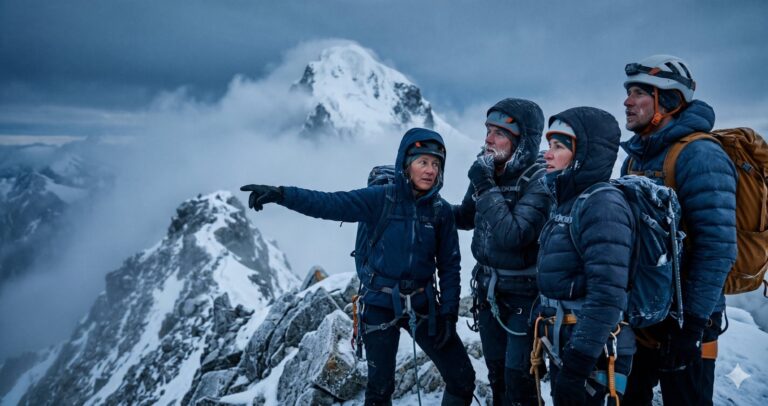
In university cohorts studying New Product Development, the frameworks always look clean. The progression from idea to execution is graphed as a linear, predictable ascent. But when you leave the classroom and operate at the extreme edges of enterprise tech — or navigate a literal crevasse field — that linear model immediately shatters.
For the last decade, corporate leadership has been obsessed with “Basecamp.” The prevailing philosophy prioritized soft metrics: performative empathy, relentless consensus-building, and maintaining a frictionless environment. Leaders were trained to act like camp counselors, ensuring everyone felt heard and comfortable.
But Basecamp is a terrible place to test a team.
Across 65 polar expeditions and all 7 Summits, the rule remains absolute: you do not discover a team’s actual culture until the weather turns, resources deplete, and the biological adrenaline crash hits. Right now, saturated markets and the pace of automated execution are forcing every enterprise team out of the tent and onto the ice. The legacy playbook is broken.
To build teams capable of extreme execution, organizations are abandoning individualistic leadership theories and adopting four structural shifts.
Human-AI “Rope Teams” and the Judgment Shift
We are past the point of treating AI as a novel software tool. Algorithms are now active, asynchronous team members. AI reliably executes the baseline tactical outputs — from generating code architectures to programmatic SEO.
This forces a massive, uncomfortable shift in human leadership. If you are a leader managing tactical output, you are obsolete. The value of the human executive has shifted entirely to setting operational boundaries, managing the psychological endurance of the team, and exercising raw, unfakeable judgment. When the algorithm’s logic fails or the data goes blind, only human intuition keeps the rope team from walking off a cliff.
Operationalized Conflict (Engineered Storming)
Traditional management training treats conflict as a cultural failure to be de-escalated immediately. The new imperative is designed friction.
An unweighted rope is just a theory of safety. You can inspect an anchor all day, but you only know it holds when you put your full body weight on it. Elite organizations are no longer preserving the polite, collegiate phase of team building. They are implementing strict, operational vocabularies for escalating risks and explicitly rewarding dissent. They deliberately stress their fragile systems during low-pressure periods, ensuring the team learns how to disagree safely before a Q4 crisis forces a real load onto an untested system.
“An unweighted rope is just an idea of safety. The team that never Stormed doesn’t have a culture. It has a ceasefire.”
The Death of the “Final Decision”
Legacy strategy taught leaders to solve problems using binary logic — score the attributes, pick a winner, and move forward.
Treating structural organizational tensions like solvable math problems guarantees the next crisis. You cannot “solve” the tension between Centralized Control and Team Autonomy, or Human Judgment and AI Velocity. They are polarities to be managed, not problems to be fixed. The most advanced teams build frameworks to carry both opposing forces simultaneously, recognizing that over-indexing on one pole inevitably suffocates the system.
“You can’t solve a polarity. You can only carry both ends until your shoulders are strong enough.”
Forensic Listening Over Emotional Validation
At 20,000 feet, simple emotional validation fails. Nodding and mirroring feelings does not keep a project on track when oxygen and margins are critically constrained.
True empathy is no longer a passive soft skill; it is a critical data-extraction tool. It is a forensic exercise in active mining. Leaders must understand exactly how team members process risk, how their communication degrades under cognitive load, and most importantly, what they are choosing not to say because they fear the operational hierarchy.
“What a team chooses not to say is the data. The rest is decoration.”
The era of the frictionless baseline is over. The teams that survive the current market compression won’t be the ones with the best culture at Basecamp. They will be the ones whose anchors hold when the rope finally goes taut.