If you have watched a room of smart people ignore an obvious risk because nobody wanted to be the one to name it, this piece is for you. The failure mode isn’t intellectual. It is social. The pre-mortem is a specific mechanism for changing the social math so the concerns already in the room can actually surface.
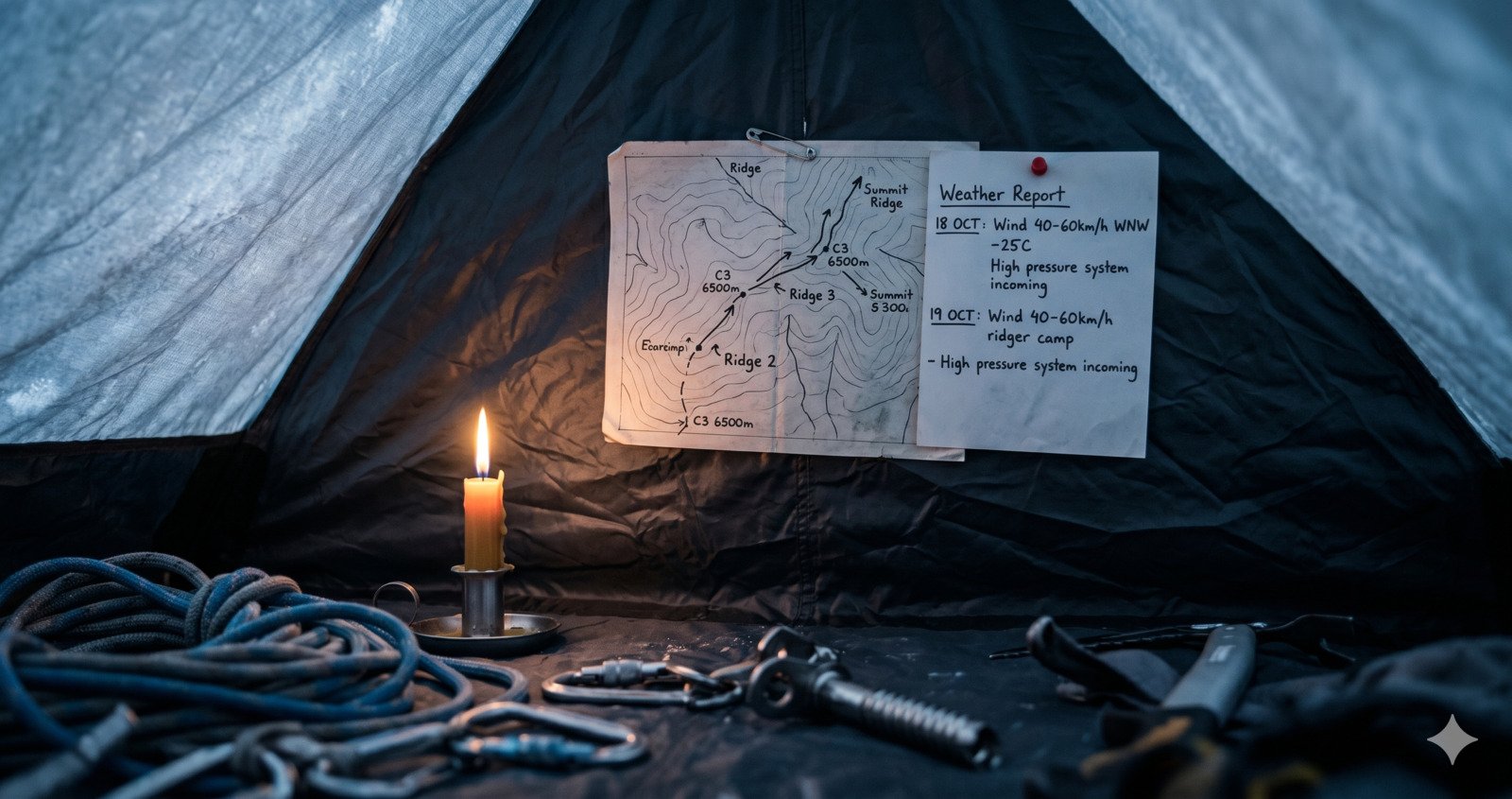
There is a conversation that happens at base camp the night before a serious summit attempt that most expeditions skip. And the ones that skip it are statistically more likely to end badly.
It is not the gear check. Everyone does the gear check. It is not the route review. Everyone does the route review. It is the conversation that requires a specific and uncomfortable reframe. It is tomorrow night, and something went seriously wrong today. What happened?
Not: what might go wrong? That question produces a list of acknowledged risks, politely enumerated, and a set of standard mitigations applied to each one. It is a useful exercise. It is not this exercise.
This exercise asks you to treat the failure as established fact and work backward. The summit attempt failed. Someone got hurt, or the team had to turn back at the wrong moment, or the weather window was misread, or an anchor failed on the descent. It happened. The question is not whether it will happen. It already did. The question is: how?
The difference between those two questions is not semantic. It is neurological. And the conversation it produces is entirely different.
Why “what might go wrong” doesn’t work
In any group preparing for a high-stakes endeavor (an expedition, a product launch, a strategic pivot, a restructuring) asking “what might go wrong?” activates a specific social dynamic that almost always produces an incomplete answer.
The person who raises the most serious concern is implicitly positioning themselves as the pessimist, the doubter, the person who doesn’t believe in the plan. In a team that has spent months building momentum toward a goal, that social position is costly. So concerns get modulated. The serious risk gets introduced as “one thing worth noting” rather than “I think this plan has a potentially fatal flaw.” The team nods. The concern is logged. The planning continues.
This is not cowardice. It is rational social behavior. The cost of naming a serious problem is absorbed entirely by the person who names it. The benefit, the plan actually gets fixed, is distributed across the whole team. The math almost always produces silence or understatement.
The pre-mortem changes the math.
The grammar of failure
“What might go wrong?” is a conditional question. It asks for predictions. Predictions are owned by the person who makes them. If the prediction is wrong, the predictor loses credibility. If it is right and the concern was dismissed, the predictor is in the socially awkward position of having been correct. Either way, the social cost of the specific prediction is borne by the individual.
“It went wrong. What happened?” is a forensic question. It asks for an explanation of a fait accompli. The failure is already established as fact. There is nothing left to predict and nothing left to defend. The team’s job is simply to reconstruct the mechanism. The social cost of naming the failure mode drops to nearly zero, because you are not predicting doom. You are solving a puzzle that has already resolved.
In my New Product Development classes, I use this as an ideation exercise in inverted form. Design the worst possible version of this product. Not: what are the risks of our current design? Design the worst mobile phone you can imagine. The inversion produces a specific kind of creative ruthlessness that the forward question never does, because nobody is defending their design decisions when the explicit goal is to make something terrible.
The pre-mortem is the same mechanism applied to risk. You are not asking the team to predict failure. You are asking them to explain it. The explanation, almost invariably, contains the specific, named failure modes that the polite risk assessment buried.
“You’re not the pessimist who predicted failure. You’re the analyst who explained it. Those are completely different social positions, and the second one is available to everyone in the room.”
What the pre-mortem actually produces
The research on pre-mortems (Gary Klein’s work is the most rigorous) shows that teams using the technique identify significantly more failure modes than teams using conventional risk assessment. But the number undersells the mechanism. The pre-mortem doesn’t just produce more items on the risk register. It produces different items.
The failures that surface in a pre-mortem are the ones that were too socially expensive to name in the conventional risk assessment. The interpersonal problem on the team that everyone knows exists and nobody has said out loud. The assumption in the plan that the most senior person made and that nobody has been willing to challenge. The dependency on a single person or system that everyone privately knows is a single point of failure but that pointing out would create a political problem.
These are the failures that kill expeditions. They are not the ones on the risk register. They are the ones in the room, unspoken, that everyone privately knows about and nobody has made the social investment to surface.
The pre-mortem surfaces them because the grammatical shift changes the incentive structure. You are not the pessimist who predicted failure. You are the analyst who explained it. Those are completely different social positions, and the second one is available to everyone in the room.
Running it
The mechanics are simple. Before the launch, the pivot, the restructuring, the summit attempt, gather the team and state the following. It is six months from today and this initiative has failed. Not failed quietly. Failed visibly and significantly. I need each of you to write down, independently, in the next five minutes, what happened. What was the specific failure mechanism?
Independent writing before discussion is not optional. It prevents the first person to speak from anchoring the group’s analysis. The most junior person’s failure scenario is as likely to be correct as the most senior person’s, and the independent writing ensures it gets captured before the social hierarchy reasserts itself.
Then surface the scenarios. Not to debate them or to reassure the group that they won’t happen. To find the two or three that multiple people identified independently. Those are the ones with the highest signal. The failure modes that appear in multiple independent scenarios are the ones your plan hasn’t adequately addressed, regardless of whether they appear on the official risk register.
Then fix those specific failure modes. Not “build contingency plans” in the abstract. Identify the precise change to the plan that would prevent the specific mechanism several people described.
That is the pre-mortem. It is not a risk management exercise. It is a permission structure for naming the things everyone already knows.
What it has in common with aim off
The pre-mortem and the aim-off technique share the same underlying logic. Sometimes the most direct path to a destination is a deliberate detour.
Aim off says: in genuine directional ambiguity, deliberately go to the wrong place so you know with certainty which direction the right place is from there.
The pre-mortem says: deliberately inhabit the failure so you can see the plan from the vantage point that conventional planning cannot reach. The vantage point of someone for whom the outcome is no longer uncertain.
Both techniques work by removing the social and cognitive cost of the honest answer. Aim off removes the cost of being wrong by making being wrong the explicit goal. The pre-mortem removes the cost of predicting failure by making the failure already a fact.
In both cases, the detour is not a failure of navigation. It is the navigation.
THE TEAM TEST
Before your next significant launch, pivot, or commitment, run the pre-mortem.
Five minutes of independent writing. No discussion yet. One question. It is six months from today and this failed. What happened?
Read the scenarios. Find the two or three failure modes that appeared independently in multiple people’s answers. These are the things your plan hasn’t addressed that multiple people on your team privately know about.
Now ask the harder question. Why didn’t those concerns surface in the normal planning process? What was the social cost of naming them that made it easier to not name them.
That social cost is the real risk. The failure mode itself is usually fixable. The environment that buried it is the thing that will bury the next one too.
The pre-mortem doesn’t just improve the plan. It diagnoses the room.