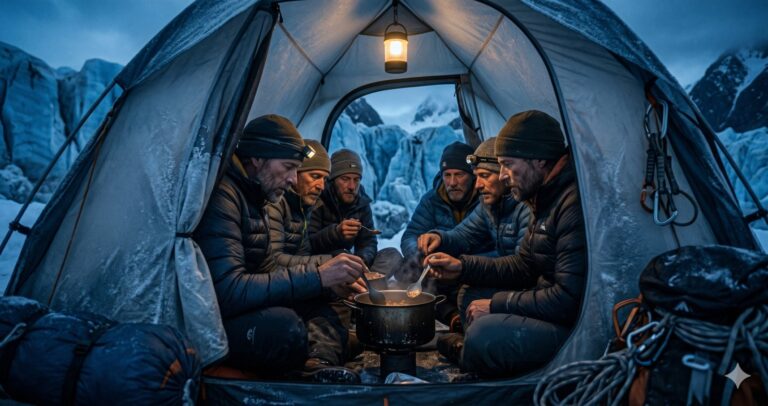
If you have watched a high-performing team fracture during a crunch and attributed it to personality conflicts, this piece is for you. The behavior wasn’t the problem. The environment eliminated every other outlet for the pressure, and the pressure did what pressure always does. It found the nearest surface.
By hour eighteen, it wasn’t the cold anymore.
The tent had held. The anchors were solid. The food situation was manageable. What was failing, slowly and without drama, was the social infrastructure that makes three people in a very small space not destroy each other.
The storm that pins an expedition team in a tent for four days does not test technical climbing ability. It tests something more fundamental and less discussed. The capacity to maintain functional human systems under conditions of sustained confinement, physical discomfort, sleep deprivation, and complete removal of the external world that normally absorbs and dilutes interpersonal friction.
In normal environments, that friction dissipates. A colleague who leaves dishes in the sink is mildly irritating. In a tent at minus thirty, surrounded by wind noise that makes conversation require effort, where every degree of warmth is rationed and every movement disturbs someone else’s equilibrium, the same behavioral pattern can become, by hour eighteen, a genuine threat to team cohesion.
Not because the stakes of the dishes have changed. Because the environment has eliminated every other outlet.
This is the phenomenon I call tent ecology. The specific, active management of the interpersonal environment in conditions where physical confinement and sustained stress remove all the usual buffers. It is not a soft skill. It is a survival skill. And it produces the single most important leadership insight I have taken from expedition environments into the organizations I advise.
Operational friction is interpersonal friction in disguise
The pattern is almost universal in high-pressure organizational crunch periods, and almost universally misdiagnosed.
A team enters a six-week product launch sprint. The first two weeks are energized. The shared goal creates cohesion, the visible progress creates momentum, the collective investment suppresses the interpersonal static that is always present in any group of people working closely together. By week four, something starts to shift. The same behaviors that were tolerable in week two are now generating friction. The engineer who doesn’t respond to Slack messages promptly. The designer who revises after sign-off. The PM who changes priorities without full team consultation.
By week five, the team lead is managing what looks like a people problem. Personalities clashing, communication breaking down, interpersonal tension making the work harder. They run a team check-in. They address the specific behaviors. The friction reduces temporarily and then returns.
What they are almost never asking is the more accurate question. Is this interpersonal friction, or is this operational friction that the team is experiencing as interpersonal friction because the crunch has eliminated every other place for it to go?
In the tent, you cannot take a walk. You cannot call a friend. You cannot find a quiet space to process the low-grade frustration that builds in any confined system. The frustration goes somewhere, and the nearest available target is the person who just shifted their sleeping position and let in a draught of cold air. That person is not the problem. They are the outlet.
In the sprint, the team cannot decompress between the work and the next conversation. The frustration goes somewhere, and the nearest available target is the behavior of the colleague they are most proximate to. That behavior is not the problem. It is the outlet.
The leader who tries to fix the interpersonal dynamic without addressing the underlying operational pressure is treating the symptom while the condition worsens.
“Operational friction is interpersonal friction in disguise. The behavior is not the problem. It is the outlet.”
The microscopic acts of grace
What actually holds a tent team together over four days of storm is not conflict resolution. It is a continuous, distributed practice of small behavioral disciplines that prevent friction from accumulating to a point where it becomes structural.
Who gets the first cup of hot water. How gear is arranged so that retrieving one thing doesn’t disturb everything else. The discipline of not sighing audibly when someone asks you to move. The decision to process your own frustration internally before it becomes a tone, a word, an expression that shifts the atmospheric pressure in three square meters of nylon.
None of these is dramatic. None of them requires a conversation about feelings. Each of them is a micro-decision made by someone who understands that in a confined high-pressure environment, the cumulative quality of these micro-decisions determines whether the team remains functional or begins to fragment.
The organizational equivalent exists in every sustained crunch. The team member who responds to a message at 9pm not because they had to but because they understood that the response reduces someone else’s anxiety overnight. The leader who keeps the status meeting to fifteen minutes when they could justify running it longer, because in week four of a six-week sprint, fifteen minutes of reclaimed time is worth more than the additional agenda items. The PM who absorbs the client’s frustration before it reaches the team, because the team’s reserves are not renewable in the current conditions.
These are not heroic acts. They are the architectural discipline of tent ecology applied to the organizational environment.
What the leader actually manages
The leader’s specific role in tent ecology is not to model the micro-behaviors themselves, though that matters, but to actively manage the conditions that make those behaviors necessary.
On the mountain, this looks like: calling the rest stop before someone needs to ask for it. Distributing gear weight so that the person carrying the most yesterday carries the least today. Noticing when the conversation energy has dropped and naming it rather than pushing through. Making the decision to stay in the tent for another day when the weather is marginal, rather than pushing because everyone is stir-crazy. Stir-crazy and exhausted is a worse combination than stir-crazy and rested.
In the organization, this looks like: recognizing that by week four of a sprint, the team’s decision quality has degraded in ways they cannot see themselves. Deliberately reducing the number of decisions that require the team’s energy rather than adding to them. Absorbing organizational complexity so that the team can focus on the work. Creating a specific space, not a general check-in, for the team to name the operational pressures they are experiencing, because the naming itself is a pressure-release valve that prevents the pressure from converting into interpersonal friction.
The most important single intervention available to a leader in a sustained crunch is the deliberate creation of buffer. Psychological, temporal, communicative. Between the operational pressure and the team’s interpersonal environment. This is not about protecting the team from reality. It is about ensuring that the friction produced by reality moves through managed channels rather than accumulating as unresolved interpersonal debt.
Unresolved interpersonal debt in a team under sustained pressure is the organizational equivalent of ice forming on the inside walls of the tent. Individually, each drop of condensation is trivial. Cumulatively, they create conditions that are genuinely dangerous. Not because of any single failure but because of what happens when the system can no longer absorb the accumulation. Cumulatively, they create conditions that are genuinely dangerous — not because of any single failure but because of what happens when the system can no longer absorb the accumulation.
THE TEAM TEST
You are currently in a crunch, or you recently came out of one. Think about the interpersonal friction that surfaced during the highest-pressure period.
Now ask the harder question. How much of that friction was actually interpersonal, rooted in genuine personality conflicts or values misalignments? And how much of it was operational pressure that had no other place to go?
If the honest answer is that the same people who were generating friction in week five are working effectively in the current lower-pressure period, the friction was tent ecology, not team dysfunction. The behaviors didn’t change. The buffer did.
The next time you enter that tent, the next sprint, the next crunch, the next launch phase, the question to ask at the beginning, not the end, is: what is the buffer architecture? Not what do we do when the friction surfaces. What do we build, before we close the zipper, so that it doesn’t have to?